I recently led an engaging hands-on workshop at ABBYY DevCon 2025. The session, "Creating a Document Processing MCP Server," was crafted for developers eager to explore advanced workflow automation, focused on constructing a Model Context Protocol (MCP) server tailored for intelligent document processing (IDP) tasks. MCP is one of the hottest technologies in the AI ecosystem, so I was thrilled to give a presentation on its fundamentals. Here’s an overview of the workshop, its objectives, and the interactive exercises participants tackled.
Want to try some hands-on MCP Server exercises? Access the workshop materials.
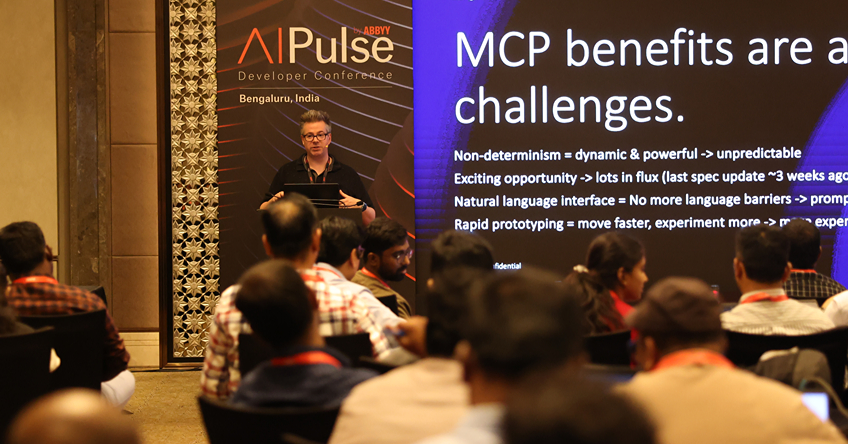
A deep dive into MCP servers
The workshop was centered on building an MCP server designed to streamline a typical bank account onboarding process. By integrating a range of cutting-edge tools and techniques, participants learned how to manage tasks including document uploads, data extraction, validation, and final submission.
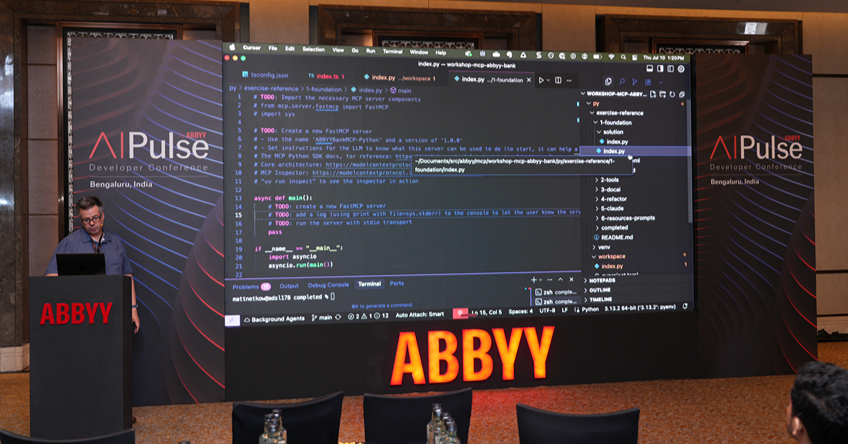
Why MCP servers matter
Model Context Protocol, or MCP, is an open standard that bridges large language models (LLMs) with various data sources and tools, enabling developers to design dynamic workflows. The server built during this workshop demonstrated how MCP serves as both an engine and an orchestrator, bringing both determinism and scalability to complex IDP scenarios. Key features of the MCP server covered in the workshop included:
- Document processing automation: Eliminate manual data entry through structured workflows.
- Real-time insights and validation: Verify identity and residency documents on the fly.
- Extensibility: Seamlessly integrate additional tools, prompts, and external resources as needed.
Hands-on learning experience
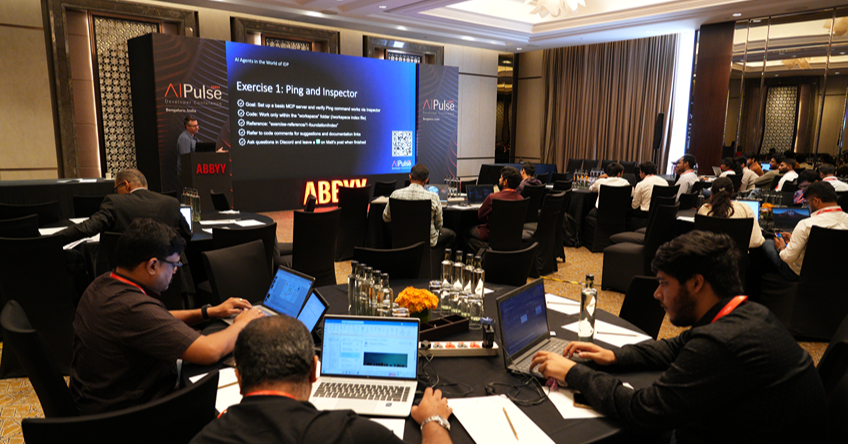
My main focus of the workshop was ensuring an interactive experience. I broke the material into manageable sections with practical coding exercises after each one. Participants were able to immediately apply their knowledge, receive feedback, and enhance their understanding incrementally. Here’s a high-level overview of what was covered:
-
MCP fundamentals
The session started with an introduction to MCP architecture and its benefits within document processing workflows. Attendees learned how MCP implements transports, clients, and servers to handle requests and orchestrate operations effectively. -
Setting up and testing an MCP server
Participants began hands-on by setting up a basic MCP server, verifying its functionality using the MCP Inspector debugging tool. This phase focused on understanding the foundational structure and testing server responses to ensure accuracy. -
Document processing with ABBYY Document AI API
The workshop progressed into integrating the ABBYY Document AI API for optical character recognition (OCR). This step highlighted the importance of leveraging robust, domain-specific OCR tools to avoid issues like hallucinated data, common with general-purpose LLMs. Attendees worked on converting utility bill uploads into structured data, demonstrating real-world applications of IDP. -
Tool and resource management
Exercises included defining and implementing server tools to process and validate user data. Participants learned about incorporating a “human-in-the-loop” approach, ensuring secure and effective operations when handling sensitive data. -
Extending MCP with Claude integration
Expanding the server's capabilities, participants explored integration with Claude Desktop for creating prompts and guiding workflows. This step allowed for experimenting with adaptive responses, making workflows more dynamic and user focused.
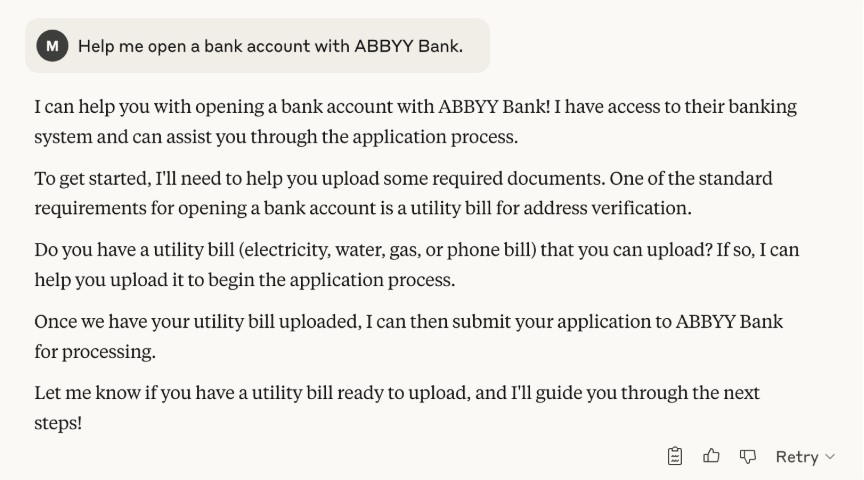
At the end of the workshop, we had built a complete bank account opening workflow:
- From Claude Desktop, the user enters a prompt: "Help me open a bank account with ABBYY Bank."
- The LLM, connecting to the MCP server, recognizes that the user needs to upload a utility bill.
- If the info looks correct, the user confirms that the Server can submit the application to the bank.
- The LLM responds, "Excellent! Your bank account application has been successfully submitted to ABBYY Bank. They'll be in touch with next steps."
Explore the workshop at your own pace
While the live session provided a vibrant and collaborative atmosphere, anyone interested can take the workshop independently. To facilitate this, all code and step-by-step instructions are available in a dedicated GitHub repository:
The repository, available in Python or TypeScript, includes everything needed to build and test MCP-based workflows, from environment setup to live debugging tools and reference exercises. Developers can also experiment with the next steps suggested in the workshop, such as incorporating new validation types or extending the server for additional document workflows.
Share your journey
If you’re ready to learn MCP fundamentals and how to incorporate intelligent document processing, the "Creating a Document Processing MCP Server" workshop is an excellent place to start. Explore the repository, complete the exercises, and bring your knowledge into real-world projects. We'd love to hear your feedback and see the innovations you build with MCP! Let us know when you've completed the workshop by tagging me (@dotNetkow) or ABBYY on LinkedIn or X.